Calling in the Bard: Walt Freeman returns for Robbie Burns Night
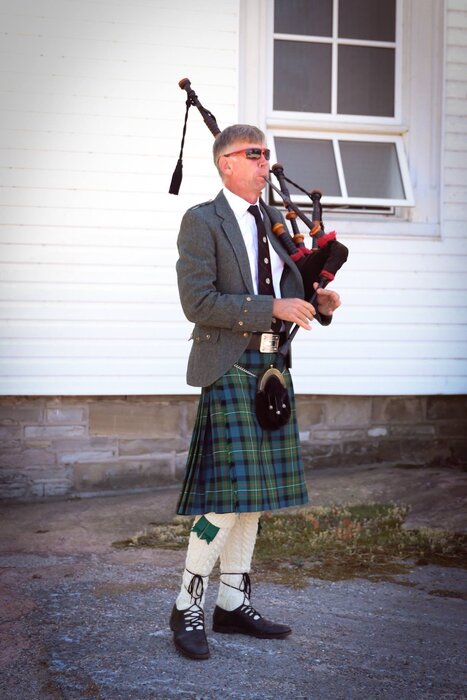
Some nights just aren’t the same without certain people. Some events have the bulk of their personality dictated by one character. And some people can really do a lot of different things, setting a scene and a flavour. With his deep, husky voice, his thick Scottish accent and his haunting bagpipes, it can’t be understated how perfect this man is for the tradition of reciting and reviving the annual Robbie Burns Supper at The Cove on Saturday, January 24, 2026. Come see Walt Freeman in action! Call for reservations 613.273.3636. Details and reservations. https://kingstonlive.ca/show/883705/view
Seamus Cowan: We wish you a great welcome back from everyone at The Cove, including the annual Robbie Burns Supper crowd! Burns was the consummate poet and free thinker. You have done so well to encapsulate the persona of Burns,being our host and MC for these annual festivities. What does Robbie Burns mean to you?
Walt Freeman: To be honest, I did not truly understand the significance of Burns until I joined the Rob Roy Pipe Band and Highland Dancers in Kingston. They put on a Burns Night dinner every year. These events filled in the blanks for me. His biography and the multitude of songs sung and poems recited amazed me. I am so impressed with songs like "A Man’s a Man for All That" with its message of equality for everyone and "Auld Lang Syne" with its message of friendship and unity. The Cove is such a wonderful venue for this kind of celebration. I am delighted to be asked back each year.
Q: Being a bagpiper, it’s clear that you have some Scottish connections and have enjoyed the music of Scotland for years. Does playing the pipes run in the family and do you play any other instruments?
Walt: With respect to my Scottish connection? My mother's maiden name was Ferguson and her father, Gramps, came to Canada from Glasgow after World War I. He totally embraced his new country, so much so that when I was young and asked to go to a Highland games in the area, his response was "what would you want to do that for?" Granny, however, had a musical brother, his name was Walter as well so maybe that did it! My siblings and I all took piano lessons but I was the only one who stayed with it. I certainly appreciated the bagpipes but it never occured to me to ask my parents for lessons. I was content playing the piano.
Q: I don’t think many people really understand the bagpipes except for knowing the most famous of all tunes, Scotland, The Brave. What inspired you to play the pipes and where did you develop your sound?
Walt: After getting married back in 1980, my wife Heather decided to take Highland Dance lessons with Rob Roy in Kingston. She enjoyed dancing very much. When she registered for a second year of classes, she suggested that I could always go with her and take bagpipe lessons. I could not have predicted that our lessons would lead to playing/dancing with the band for 20 memorable years.
Q: Playing the bagpipes is an extremely physical thing. It requires all kinds of wind in order to continue to keep the bags full. Having focus and the ability to multitask seems to be a necessity. Can you tell us more about any challenges that you have faced with the instrument and how it is played?
Walt: Multi-tasking is a good way to describe it.
Step 1: Students learning to play the bagpipes start on a practice chanter. The chanter is a long cylinder with holes drilled in it. There are 9 notes and each note is created by covering the appropriate hole in the chanter. Once the student can play the scale, continue to Step 2: Get some printed music and learn where each note on the page is on the chanter. Playing the piano gave me a bit of an edge because I could easily read the music and place my fingers on the right notes.
Step 3: bagpipe music is distinguished by many special embellishments such as grips, grace notes, throw D's and many more. These are played between the melody notes to enhance the sound of the tune. Getting the embellishments right takes a lot of practice.
Step 4: memorize the music.
Step 5: move from practice chanter to bagpipes. Students must learn to tune the drones (3 pipes resting on the shoulder) and the required amount of blowing to make it all work.
Step 6: practice, practice, practice. Finally, feeling confident with the instrument, join a pipe band and learn how to march in step with everyone else. To recap: blow the right amount of air, play the tune at the correct tempo and march in step. Nothing to it!
Q: No doubt, the bagpipes are an instrument with a rousing sound that truly brings out something ancient and primal in the listener. With its drone and human-like timber on top, it has the ability to transport us. Why do you think this instrument that has a lineage of thousands of years has stood the test of time?
Walt: There is something primal about music of all kinds. It seems that every part of the world has ancient instruments and styles of music. Scottish Gaelic proverb: "Thig crìoch air an t-saoghal, ach mairidh gaol is ceòl". It translates to: "The world will end, but love and music will endure".
Posted: Jan 19, 2026